Sunday, 7 May 2023

[07052023] De Bono's Six Hats


Edward de Bono is a Maltese physician, psychologist, and author who is best known for his work on creative thinking. One of his most popular and influential ideas is the "Six Thinking Hats" method, also known as the "de Bono Thinking Hats" method.

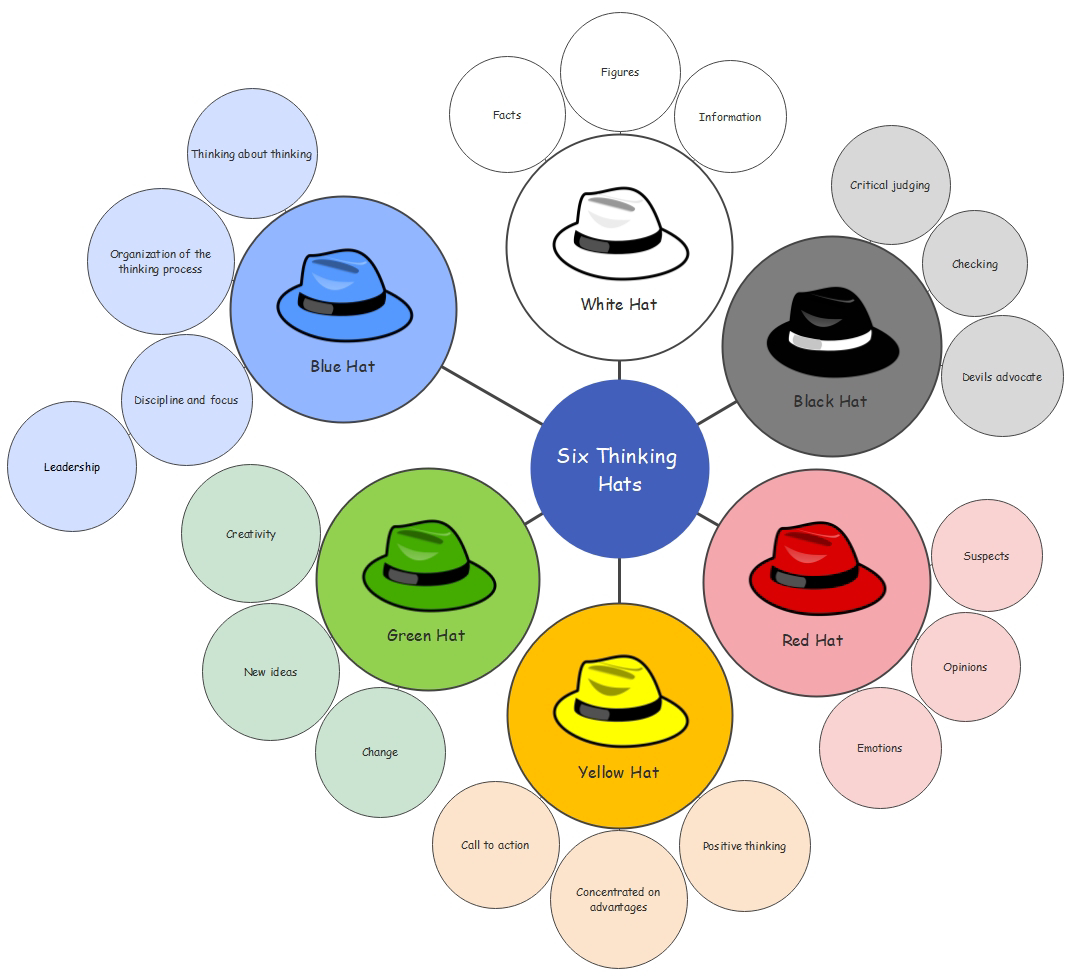
The Six Thinking Hats is a technique for group discussion and individual thinking, where participants are encouraged to think about a problem or situation from six different perspectives, each represented by a different "hat" color. The six hats are:

1. White Hat - focuses on facts, data, and information. 
2. Red Hat - represents emotions and feelings. 
3. Black Hat - considers potential problems and negative aspects of the situation. 
4. Yellow Hat - looks for the benefits and opportunities. 
5. Green Hat - encourages creativity and innovative thinking. 
6. Blue Hat - facilitates the thinking process and controls the discussion.

By using these different hats, de Bono believed that individuals and groups could approach problems and situations in a more structured and productive way. Each hat represents a different type of thinking, and by switching hats, participants can consciously change their approach to the problem at hand. This can help to prevent groupthink and promote more creative, comprehensive, and effective thinking.

Overall, the Six Thinking Hats is a powerful tool for decision-making, problem-solving, and brainstorming that has been used by individuals and organizations around the world to improve their thinking processes and outcomes.

Friday, 5 May 2023

[05052023] Be yourself!

It's important to recognize that we all have certain factors in our lives that can influence our decisions and actions, such as people, money, and past experiences.

However, it's essential to remember that ultimately, we have the power to control our own lives and make our own choices. It's crucial to not let external factors control us and dictate our decisions. Instead, we should take charge of our lives and make choices that align with our values, goals, and aspirations.

It's also important to learn from past experiences and use them as lessons to grow and improve. We shouldn't let our past define us or hold us back, but rather use it as a tool for personal growth and development.

In conclusion, it's essential to recognize and acknowledge the factors that influence our lives, but we should strive to be in control of our own lives and make choices that align with our values and goals. We should learn from our past experiences and use them as tools for personal growth and development.

[05052023] وَلَا تَسْتَوِي الْحَسَنَةُ وَلَا السَّيِّئَةُ ادْفَعْ بِالَّتِي هِيَ أَحْسَنُ فَإِذَا الَّذِي بَيْنَكَ وَبَيْنَهُ عَدَاوَةٌ كَأَنَّهُ وَلِيٌّ حَمِيمٌ

وَلَا تَسْتَوِي الْحَسَنَةُ وَلَا السَّيِّئَةُ ادْفَعْ بِالَّتِي هِيَ أَحْسَنُ فَإِذَا الَّذِي بَيْنَكَ وَبَيْنَهُ عَدَاوَةٌ كَأَنَّهُ وَلِيٌّ حَمِيمٌ * وَمَا يُلَقَّاهَا إِلَّا الَّذِينَ صَبَرُوا وَمَا يُلَقَّاهَا إِلَّا ذُو حَظٍّ عَظِيمٍ  [فصلت 34 - 35]

"ادفع بالمثل الأحسن، حتى إذا كان هناك عداء بينك وبين الآخرين". والمعنى العام لهذه العبارة هو أنه يجب عليك الاستجابة للعداء والانتقام بطريقة أفضل وأكثر نضجًا، بدلاً من التعامل مع الأمور بشكل عدائي وعنيف. وهذا يعني الرد على السلبيات بالإيجابية والتركيز على الأشياء الإيجابية التي يمكن أن تقوي العلاقة بينك وبين الآخرين.

 Respond with the best response when
  there is animosity between you and others." The general meaning of this expression is that one should respond to hostility and seek revenge in a better and more mature way, rather than dealing with things in a hostile and violent manner. This means responding to negativity with positivity and focusing on positive things that can strengthen the relationship between you and others.

Thursday, 4 May 2023

[04052023] Procrastination is the thief of time

"Procrastination is the thief of time" is a well-known proverb that means delaying or putting off tasks can waste valuable time and lead to missed opportunities. It implies that procrastination is a form of theft because it robs us of the time that we could have spent productively. 

When we procrastinate, we might feel like we are taking a break or relaxing, but in reality, we are only delaying the inevitable and often end up rushing to complete tasks at the last minute. This can lead to suboptimal results, stress, and a feeling of being overwhelmed.

To avoid the negative consequences of procrastination, it's important to prioritize tasks and break them down into smaller, manageable steps. We can also set deadlines for ourselves and hold ourselves accountable for completing tasks on time. Additionally, we can use tools and techniques such as time blocking, Pomodoro technique, and task lists to increase our productivity and efficiency. By taking these steps, we can avoid the thief of time and make the most of the time we have available.

Wednesday, 3 May 2023

[03052023] The Fear of Irrelevance and the Importance of Adaptation and Innovation


The fear of irrelevance is a common phenomenon among individuals and organizations alike. It is the fear of becoming obsolete or outdated in an ever-changing world where new technologies, trends, and ideas emerge at a rapid pace. In the business world, this fear can drive organizations to continuously innovate, adapt, and stay client-centered. However, ignoring this fear can lead to stagnation and eventual failure. Let's take a closer look at this phenomenon and its impact on organizations.

The fear of irrelevance is the fear of becoming irrelevant or outdated in a rapidly changing world. It is a natural human response to uncertainty and the unknown. In the business world, this fear can drive organizations to continuously innovate, adapt, and stay client-centered to avoid falling behind.

Several organizations have successfully adapted to changes in their industries and overcame the fear of irrelevance. For example, ChatGPT, Amazon, Netflix, Microsoft, and Apple are organizations that have embraced change, remained agile, and focused on innovation. By staying up-to-date with the latest trends and consumer preferences, these organizations have been able to thrive and maintain their relevance.

Google is another organization that has been at the forefront of AI innovation for many years. By leveraging AI technology to improve its products and services, Google has been able to remain at the cutting edge of the search engine market and expand into other areas such as healthcare, energy, and environmental sustainability.

On the other hand, there are several examples of organizations that failed to adapt and adopt to changing circumstances, ultimately leading to their downfall. For instance, Kodak and Nokia were once market leaders in their respective industries but failed to embrace digital photography and smartphones, respectively. As a result, they were left behind by competitors who were quicker to adapt to changing consumer needs and preferences.

The fear of irrelevance can be a powerful motivator for organizations to continuously innovate and be client-centered. By embracing change and being proactive in identifying and meeting the evolving needs of their clients, organizations can remain relevant and competitive in their industries. This fear can also help organizations to develop a growth mindset that emphasizes continuous learning and improvement.

However, ignoring the fear of irrelevance can lead to stagnation and eventual failure. Organizations that become too comfortable with the status quo and fail to innovate or adapt to changing circumstances risk being left behind by competitors who are quicker to adapt.

In conclusion, the fear of irrelevance can be a double-edged sword for organizations. On the one hand, it can be a powerful motivator for innovation and client-centeredness. On the other hand, ignoring this fear can lead to stagnation and eventual failure. By embracing change, staying agile, and focusing on innovation, organizations can not only survive but thrive in the face of rapid technological change and shifting consumer preferences.

Monday, 1 May 2023

[01052023] The Culture of Reading: Addressing the Consequences of Illiteracy and a Refusal to Read


The Culture of Reading: Addressing the Consequences of Illiteracy and a Refusal to Read


A culture of reading is a society that values and promotes the habit of reading, including reading for pleasure, knowledge, and critical thinking. However, illiteracy and a refusal to read can prevent the development of a culture of reading and have serious consequences for individuals and society.


Illiteracy, or the inability to read, can prevent individuals from accessing important information, opportunities for education, and meaningful employment. Without basic literacy skills, individuals may struggle to function in daily life, leading to social isolation, poverty, and limited opportunities for personal growth. The consequences of a lack of engagement with literature can be seen in examples of societies that have collapsed or been left behind. For instance, in some ancient civilizations like the Mayan civilization, the absence of a system of writing has made it difficult for scholars to fully understand and appreciate their contributions to human civilization.


Furthermore, a refusal to read, despite the ability to do so, can have negative consequences on individuals and society. It can limit critical thinking skills, result in a lack of empathy and understanding of others, and create a susceptibility to misinformation and propaganda. When individuals refuse to read or engage with literature, they miss out on opportunities for personal growth and acquiring new knowledge. In turn, this can lead to a lack of innovation, creativity, and progress.


Addressing illiteracy and a refusal to read is crucial in promoting a culture of reading. Education programs and initiatives can help to provide access to literacy resources and promote a love of reading. Encouraging individuals to engage with literature, regardless of format, can lead to improved cognitive function, enhanced language skills, and social and civic engagement. It can also help to foster creativity and innovation, reduce social inequality, and promote the understanding of diverse perspectives.


In conclusion, a culture of reading is essential for the intellectual, social, and economic well-being of individuals and societies. Addressing the consequences of illiteracy and a refusal to read is necessary to promote a love of reading, critical thinking, and knowledge acquisition. Without a culture of reading, societies may struggle to compete in a globalized and knowledge-based economy, and individuals may miss out on opportunities for education and personal growth. Let us all strive to promote a culture of reading and continue to engage with literature to foster personal and societal growth.

[01052023] To lead!

1. 1900 - Henri Fayol - "General and Industrial Management": Fayol's approach focuses on the management of resources, including planning, organizing, and controlling.

2. 1908 - Mary Parker Follett - "The New State": Follett's approach focuses on the importance of collaboration and cooperation in organizational decision-making.

3. 1911 - Frederick Winslow Taylor - "The Principles of Scientific Management": Taylor's approach focuses on the use of scientific methods to improve productivity and efficiency in the workplace.

4. 1913 - Elton Mayo - "The Human Problems of an Industrial Civilization": Mayo's approach focuses on the importance of social and psychological factors in the workplace, including the role of leadership in motivating employees.

5. 1924 - Max Weber - "The Theory of Social and Economic Organization": Weber's approach focuses on the role of bureaucracy in organizational management.

6. 1930 - Mary Parker Follett - "The Speaker of the House of Representatives": Follett's approach focuses on the importance of collaboration and cooperation in organizational decision-making.

7. 1933 - Kurt Lewin - "A Dynamic Theory of Personality": Lewin's approach focuses on the role of social and psychological factors in personality development, including the role of leadership in shaping individual behavior.

8. 1938 - Chester Barnard - "The Functions of the Executive": Barnard's approach focuses on the importance of communication and cooperation in organizational decision-making.

9. 1947 - Abraham Maslow - "A Theory of Human Motivation": Maslow's approach focuses on the hierarchy of needs, including the role of self-actualization in individual and organizational growth.

10. 1947 - Chester Barnard - "The Functions of the Executive": Barnard's approach focuses on the importance of communication and cooperation in organizational decision-making.

11. 1954 - Rensis Likert - "New Patterns of Management": Likert's approach focuses on the importance of participatory management, including the role of leadership in creating a collaborative organizational culture.

12. 1958 - Douglas McGregor - "The Human Side of Enterprise": McGregor's approach focuses on the importance of employee motivation and engagement in organizational success.

13. 1960 - Chris Argyris - "Understanding Organizational Behavior": Argyris's approach focuses on the role of organizational learning in individual and organizational growth.

14. 1960 - Douglas McGregor - "The Human Side of Enterprise": McGregor's approach focuses on the importance of employee motivation and engagement in organizational success.

15. 1964 - Herbert Simon - "Theories of Decision-Making in Economics and Behavioral Science": Simon's approach focuses on the importance of decision-making in organizational management.

16. 1965 - Robert Blake and Jane Mouton - "The Managerial Grid": Blake and Mouton's approach focuses on the importance of balancing task and people-oriented leadership styles.

17. 1967 - Fred Fiedler - "A Theory of Leadership Effectiveness": Fiedler's approach focuses on the importance of matching leadership style to situational factors, including task structure and leader-member relations.

18. 1969 - Kenneth Thomas and Ralph Kilmann - "The Thomas-Kilmann Conflict Mode Instrument": Thomas and Kilmann's approach focuses on the importance of conflict management in organizational decision-making.

19. 1971 - Victor Vroom and Philip Yetton - "Leadership and Decision-Making": Vroom and Yetton's approach focuses on the importance of participatory decision-making in leadership.

20. 1973 - Paul Hersey and Ken Blanchard - "Management of Organizational Behavior: Utilizing Situational Approach": Hersey and Blanchard's approach focuses on the importance of adapting leadership style to the maturity level of employees.

21. 1978 - James MacGregor Burns - "Leadership": Burns's approach focuses on the importance of transformational leadership, including the role of leaders in inspiring and motivating followers.

22. 1982 - John Kotter - "The General Managers": Kotter's approach focuses on the importance of effective management in organizational success, including the role of leadership in creating a shared vision and strategic plan.

23. 1985 - Edwin Locke - "Toward a Theory of Task Motivation and Incentives": Locke's approach focuses on the role of goal-setting and feedback in employee motivation and performance.

24. 1986 - Warren Bennis - "On Becoming a Leader": Bennis's approach focuses on the importance of self-awareness and personal growth in leadership development.

25. 1988 - Peter Drucker - "The Effective Executive": Drucker's approach focuses on the importance of time management, prioritization, and decision-making in effective leadership.

26. 1990 - Gary Yukl - "Leadership in Organizations": Yukl's approach focuses on the importance of multiple factors in effective leadership, including leader behavior, organizational culture, and follower characteristics.

27. 1992 - John Kotter - "Leading Change": Kotter's approach focuses on the importance of creating a sense of urgency and a guiding coalition in leading organizational change.

28. 1994 - James Kouzes and Barry Posner - "The Leadership Challenge": Kouzes and Posner's approach focuses on the importance of inspiring and motivating followers through modeling the way, inspiring a shared vision, challenging the process, enabling others to act, and encouraging the heart.

29. 1995 - Daniel Goleman - "Emotional Intelligence": Goleman's approach focuses on the importance of emotional intelligence, including self-awareness, self-regulation, motivation, empathy, and social skills, in effective leadership.

30. 1997 - Robert House - "Path-Goal Theory of Leadership": House's approach focuses on the importance of clarifying goals, providing direction, and removing obstacles in effective leadership.

31. 1998 - Peter Senge - "The Fifth Discipline": Senge's approach focuses on the importance of organizational learning, including personal mastery, mental models, shared vision, team learning, and systems thinking.

32. 1999 - James Collins and Jerry Porras - "Built to Last": Collins and Porras's approach focuses on the importance of visionary leadership, including the role of core values, purpose, and BHAGs (big hairy audacious goals) in creating enduring organizations.

33. 2001 - Jim Collins - "Good to Great": Collins's approach focuses on the importance of disciplined leadership, including the role of level 5 leadership, disciplined people, disciplined thought, and disciplined action in achieving sustained organizational success.

34. 2002 - Marcus Buckingham and Curt Coffman - "First, Break All the Rules": Buckingham and Coffman's approach focuses on the importance of strengths-based leadership, including the role of focusing on employee strengths, providing clear expectations, and fostering positive relationships.

35. 2003 - John Maxwell - "The 21 Irrefutable Laws of Leadership": Maxwell's approach focuses on the importance of timeless principles of leadership, including the law of influence, the law of process, the law of navigation, and the law of sacrifice.

36. 2004 - Jim Collins - "Good to Great and the Social Sector": Collins's approach focuses on the importance of applying principles of disciplined leadership to nonprofit and public sector organizations.

37. 2005 - Warren Bennis - "The Art of Followership": Bennis emphasizes that effective followership is just as important as effective leadership in achieving organizational goals.

38. 2006 - Charles Duhigg - "The Power of Habit": Duhigg's approach focuses on the importance of understanding and shaping habits, including how leaders can use habits to create organizational change.

39. 2007 - Carol Dweck - "Mindset: The New Psychology of Success": Dweck's approach focuses on the importance of growth mindset, including the role of leaders in promoting a culture of learning and development.

40. 2008 - Simon Sinek - "Start with Why": Sinek's approach focuses on the importance of starting with a clear sense of purpose and vision, including the role of leaders in inspiring and motivating others to act.

41. 2009 - Clay Christensen - "The Innovator's Dilemma": Christensen's approach focuses on the importance of disruptive innovation, including the role of leaders in creating and adapting to disruptive technologies and business models.

42. 2010 - Brené Brown - "The Gifts of Imperfection": Brown's approach focuses on the importance of vulnerability and authenticity, including the role of leaders in creating a culture of psychological safety and trust.

43. 2011 - Daniel Pink - "Drive: The Surprising Truth About What Motivates Us": Pink's approach focuses on the importance of intrinsic motivation, including the role of leaders in creating conditions that foster autonomy, mastery, and purpose.

44. 2012 - Sheryl Sandberg - "Lean In": Sandberg's approach focuses on the importance of gender diversity and inclusion in leadership, including the role of women in breaking down barriers and advancing in leadership positions.

45. 2013 - Adam Grant - "Give and Take": Grant's approach focuses on the importance of generosity and reciprocity in leadership, including the role of givers, takers, and matchers in organizational success.

46. 2014 - Kim Scott - "Radical Candor": Scott's approach focuses on the importance of feedback and communication, including the role of leaders in providing honest, direct feedback in a way that is both caring and challenging.

47. 2015 - Angela Duckworth - "Grit: The Power of Passion and Perseverance": Duckworth's approach focuses on the importance of grit and perseverance in achieving long-term goals, including the role of leaders in fostering a growth mindset and creating a culture of resilience.

48. 2016 - Simon Sinek - "Together Is Better": Sinek's approach focuses on the importance of collaboration and teamwork, including the role of leaders in creating a sense of belonging and connection.

49. 2017 - Amy Edmondson - "The Fearless Organization": Edmondson's approach focuses on the importance of psychological safety, including the role of leaders in creating a culture that encourages open communication and learning from failure.

50. 2018 - Adam Grant - "Originals: How Non-Conformists Move the World": Grant's approach focuses on the importance of creativity and innovation, including the role of leaders in promoting and supporting original thinking and diverse perspectives. 

These 50 leadership theorists and their published works have had a profound impact on the field of leadership, helping to shape our understanding of what effective leadership looks like and how it can be developed and practiced. By studying these approaches, leaders can gain valuable insights and tools for becoming more effective in their roles, and organizations can benefit from the improved performance and outcomes that come with strong leadership.
[12112026] NILAI SEORANG INSAN: SEBAIK-BAIK MANUSIA ADALAH YANG PALING BERMANFAAT

✨ NILAI SEORANG INSAN: SEBAIK-BAIK MANUSIA ADALAH YANG PALING BERMANFAAT ✨ Islam mengukur darjat dan kemuliaan seseorang bukan...